Habit formation is widely misunderstood. Popular culture promotes rapid transformation timelines, but behavioral research shows habit automation is gradual and variable.
This guide consolidates research on automaticity, motivation decay, environmental design, and behavioral persistence.
1. How Long Does It Take to Build a Habit?
The most cited modern study suggests an average of 66 days to reach automaticity, with a wide range depending on complexity and context.
Motivation is not fake, but it is unreliable as a long-term behavioral driver.
Psychological research shows motivation fluctuates with emotion, stress, sleep, and novelty.
Habits sustained over time rely more on structure, environment, and identity than emotional intensity.
The “motivation-first” approach fails because behavior often precedes motivation.
Sustainable change depends on reducing friction, not increasing inspiration.
Introduction
“Just stay motivated.”
This advice dominates self-improvement culture. It implies that consistent success depends primarily on emotional drive. Yet psychological research consistently shows that motivation is unstable and context-dependent.
Dopamine responds strongly to novelty. As novelty fades, dopamine response decreases. This explains why new goals feel exciting initially and neutral later.
This drop in emotional intensity is also one of the primary reasons many people quit early. Around week three to four, enthusiasm declines while effort remains high. That predictable drop-off is explained in detail in Why Habits Fail After 30 Days: The Science Behind the Drop-Off (2026).
Behavior Often Precedes Motivation
Research in behavioral activation shows that action frequently generates motivation. Exercise improves mood after starting. Writing becomes easier after the first paragraph.
This aligns with habit research showing that automaticity develops through repetition, not inspiration. Motivation may initiate behavior, but repetition sustains it.
The structure model reduces reliance on emotional states. Environmental cues trigger behavior even when motivation is low.
For example, habit automation depends on consistent repetition across weeks. The average automaticity timeline is closer to 66 days rather than 21 or 30. You can review the data here: How Long Does It Take to Build a Habit?
Why Motivation Fails Long Term
Emotional variability
Decision fatigue
Overestimation of future discipline
Environmental friction
When novelty fades around the one-month mark, individuals often misinterpret effort as failure. In reality, this phase is expected during neural adaptation.
Friction Is Stronger Than Motivation
High friction + High motivation = unstable.
Low friction + Moderate motivation = sustainable.
Most habits fail not because people lack motivation, but because structural friction remains high. The 30-day drop-off phenomenon demonstrates this clearly. Full breakdown here: Why Habits Fail After 30 Days.
Identity-Based Reinforcement
Behavior aligned with identity persists longer.
Shift from:
“I want to exercise.”
to
“I am someone who trains consistently.”
Identity reinforcement reduces reliance on fluctuating emotions.
Practical Framework: Replacing Motivation With Structure
Define the smallest repeatable version of the behavior.
Attach it to a stable cue.
Reduce setup cost.
Remove competing friction.
Track repetitions for 8–12 weeks.
Scale gradually after automaticity strengthens.
Scaling too early increases collapse risk. This is especially common around week three to five, where many people quit. Detailed explanation: Why Habits Fail After 30 Days.
Frequently Asked Questions
Is motivation completely useless?
No. It is useful for starting behavior. It is unreliable for sustaining it.
Why does motivation fade so quickly?
Because novelty decreases and dopamine response stabilizes.
How long does it take for habits to replace motivation?
Most habits do not fail because of laziness. They fail because of structural instability.
Behavioral research shows automaticity often requires more than 30 days, with an average closer to 66 days.
The 3–6 week mark is a predictable friction phase where novelty fades and effort remains high.
Habit failure is usually caused by friction, unstable cues, emotional dependency, or unrealistic scaling.
Structural design, not motivation, determines survival beyond 30 days.
Introduction
A common pattern appears in self-improvement attempts: enthusiasm for two to four weeks, followed by gradual decline. Many individuals report that habits “just stop working” around the one-month mark.
This drop-off is not random. It reflects a mismatch between expectations and neurological adaptation timelines.
If automaticity typically takes longer than 30 days, then quitting at day 28 is not evidence of failure. It is evidence of premature evaluation.
Understanding why habits fail after 30 days requires examining motivation decay, neural adaptation, environmental friction, and identity alignment.
The 30-Day Illusion
The idea of a 30-day transformation cycle is widely marketed because it aligns with monthly planning frameworks and human preference for round numbers.
However, peer-reviewed behavioral research does not support a universal 30-day automaticity threshold.
In the Lally et al. (2009) study:
Average automaticity: 66 days
Some behaviors required over 200 days
If automaticity has not yet formed at day 30, the behavior still requires conscious effort. Effort combined with fading motivation creates dropout risk.
The 30-day mark often coincides with the decline of novelty and the persistence of cognitive load.
The Habit Formation Curve
Habit formation follows an asymptotic curve:
Rapid early improvement in consistency
Slower growth phase
Gradual plateau toward automaticity
The second phase, where growth slows, commonly occurs between weeks 3 and 6. This plateau creates the perception of stagnation.
Psychologically, individuals interpret slowed progress as failure. Neurologically, the brain is still encoding repetition patterns.
The mismatch between perception and biological adaptation drives abandonment.
Why Motivation Fades Around Week 3–4
Motivation is often driven by:
Novelty
Emotional intensity
Goal visualization
Neuroscience research shows that dopamine response decreases with repeated exposure to the same stimulus unless rewards escalate.
When novelty fades:
Emotional reinforcement weakens
Effort remains high
Reward feels delayed
Without structural support, behavior collapses.
Motivation decline is predictable. It is not a personal flaw.
Structural Reasons Habits Collapse
1. Overly Ambitious Starting Point
Many habits begin at a scale that exceeds sustainable repetition capacity.
Examples:
Starting with one-hour workouts daily
Writing 1,000 words per day immediately
Strict dietary overhauls
High friction increases cognitive load. When initial excitement fades, effort becomes unsustainable.
Micro-habit design is more durable.
2. Weak Cue Attachment
Habits require consistent triggers.
Stable cue: After brushing teeth, floss.
Unstable cue: Sometime before bed, floss.
If the behavior lacks a reliable environmental anchor, repetition remains fragile.
3. Context Disruption
Travel, stress, schedule shifts, illness, and workload changes frequently occur within a month. If a habit is dependent on ideal conditions, it collapses under variability.
Robust habits require adaptability design.
4. Identity Misalignment
If a habit conflicts with perceived identity, adherence decreases.
Example: Someone who sees themselves as “not athletic” attempting intense gym routines.
Behavioral consistency strengthens identity. However, early-stage habits require identity compatibility.
5. Emotional Dependence
When habits are tied to feeling motivated, stress or fatigue disrupts them.
Sustainable habits operate independently of mood states.
Cognitive Load and Decision Fatigue
Habits fail when they remain decision-heavy.
If daily execution requires:
Scheduling negotiations
Equipment preparation
Mental bargaining
The prefrontal cortex remains engaged. Automaticity has not yet transferred to basal ganglia processes.
Reducing decisions accelerates habit durability.
The Friction Threshold
Behavioral models suggest that every habit has a friction threshold.
Below threshold: Behavior continues.
Above threshold: Dropout risk increases.
Common friction sources:
Time cost
Physical effort
Emotional discomfort
Environmental resistance
Reducing friction below threshold is more effective than increasing motivation.
Integrating short-term reinforcement mechanisms improves survival past 30 days.
Why Missing One Day Feels Catastrophic
Research suggests missing a single repetition does not meaningfully impair habit formation. However, cognitive distortion often transforms one missed day into abandonment.
This pattern is sometimes described as the “what-the-hell effect” in behavioral psychology.
Recovery planning is more important than perfection.
Environmental Design Failures
Environment shapes behavior probability.
If healthy food is not visible, exercise tools are stored away, or distractions are accessible, friction increases.
Environment redesign often produces larger gains than willpower adjustments.
The Plateau Misinterpretation
At around 30 days, progress may feel flat.
Possible reasons:
Automaticity not yet achieved
No visible outcome improvement
Emotional novelty gone
Plateau is part of the curve. Interpreting plateau as stagnation leads to quitting.
Scaling Too Early
Individuals often increase intensity before automaticity stabilizes.
Example:
Week 1: 10-minute walk Week 3: 45-minute intense workout
Scaling before neural encoding stabilizes increases collapse probability.
Gradual scaling preserves continuity.
Stress and Habit Interference
Stress activates survival-focused neural pathways. Under stress, the brain prioritizes established habits over new ones.
If a new habit is not yet automatic, stress events within the first month may disrupt it.
This explains why life disruptions frequently end new routines.
The Identity Gap
Early-stage habits often conflict with current self-image.
Example: “I want to be disciplined” vs. “I am disorganized.”
Without gradual identity reinforcement, cognitive dissonance undermines repetition.
Identity shifts lag behind behavior.
Data-Based Realistic Timelines
Based on behavioral research patterns:
Simple habits: 3–8 weeks
Moderate habits: 6–12 weeks
Complex lifestyle changes: 3–8 months
Thirty days is often the midpoint, not the endpoint.
Designing Habits That Survive 30 Days
Step 1: Define the Smallest Repeatable Unit
Instead of: Read 30 minutes.
Start: Read one paragraph.
Repetition frequency matters more than intensity.
Step 2: Lock to a Stable Cue
After I make coffee, I will read one paragraph.
Cue stability reduces decision friction.
Step 3: Remove Setup Cost
Prepare materials in advance. Keep tools visible.
Reduce activation energy.
Step 4: Plan for Disruption
Define a minimum fallback version.
Example: If I cannot do full workout, I will do 5 push-ups.
Fallback plans preserve streak continuity.
Step 5: Track Repetitions, Not Outcomes
Tracking behavior reinforces identity and provides immediate reward.
Habits fail after 30 days primarily because expectations outpace neurological adaptation. The brain has not yet automated the behavior, novelty has diminished, and effort remains high.
Thirty days is not a verdict. It is a transition phase.
The correct strategy is not to intensify effort but to reduce friction and extend repetition.
A more productive question is not:
“Why did I fail after 30 days?”
It is:
“How can I redesign this behavior so it survives to day 90?”
The widely repeated “21 days to build a habit” claim is not supported by scientific evidence.
The most cited study suggests an average of 66 days to reach automaticity, with a range from 18 to 254 days depending on behavior and individual differences.
Habit formation depends on repetition in a stable context, behavior complexity, identity alignment, and environmental design.
Missing a single day does not meaningfully disrupt habit formation.
Sustainable habit formation is a structural process, not a motivational event.
Introduction
“How long does it take to build a habit?” is one of the most searched self-improvement questions. Popular culture often promotes simplified timelines, especially the claim that habits form in 21 days. That number is not grounded in modern behavioral research.
Understanding the actual timeline matters because unrealistic expectations cause abandonment. When people expect automaticity in three weeks and do not experience it, they interpret the delay as personal failure rather than normal neurobehavioral adaptation.
This article examines what peer-reviewed research shows, what affects the timeline, why most people quit prematurely, and how to structure habits for long-term automaticity.
What the Research Says
The 66-Day Study
The most frequently cited modern study on habit formation is by Lally et al. (2009), published in the European Journal of Social Psychology. Researchers tracked 96 participants over 12 weeks as they adopted new daily behaviors (e.g., drinking water after breakfast, exercising after work).
Key findings:
The average time to reach peak automaticity: 66 days
Range: 18 to 254 days
Automaticity increased asymptotically, not linearly
Missing one day did not significantly reduce progress
Important clarification: 66 days is an average. Some simple behaviors became automatic within a few weeks. More complex behaviors took significantly longer.
Automaticity Curve
Habit formation follows a curve:
Rapid early gains in consistency
Slowing progress over time
Plateau at behavioral automaticity
This curve contradicts the idea of a fixed timeline. Habit formation is not a countdown; it is a repetition-dependent neurological adaptation.
Why the 21-Day Myth Persists
The 21-day claim is commonly attributed to Dr. Maxwell Maltz, a plastic surgeon in the 1960s who observed that patients appeared to adjust to physical changes in about three weeks. His book, Psycho-Cybernetics, mentioned this observation informally. It was never presented as controlled experimental evidence.
Over time, motivational literature simplified the concept into a universal rule. It spread because:
It is psychologically appealing.
It creates urgency.
It is easy to market.
There is no robust scientific support for a universal 21-day habit rule.
What Determines How Long a Habit Takes
Habit formation duration varies due to multiple variables.
1. Behavior Complexity
Simple behaviors:
Drinking water after breakfast
Taking vitamins
Writing one sentence daily
Complex behaviors:
Daily gym workouts
Waking up at 5 a.m.
Writing 1,000 words per day
The more friction, the longer automaticity requires.
2. Context Stability
Habits form through cue-behavior repetition. If the cue changes frequently, automaticity slows.
Daily behaviors develop faster than weekly ones. A behavior performed once per week may require many months to become automatic simply due to limited repetitions.
4. Reward Structure
Habits that produce immediate feedback form faster. Delayed rewards (e.g., long-term fitness results) require stronger structural support.
5. Identity Alignment
Research in behavioral psychology indicates that behaviors aligned with self-concept persist more consistently. When actions reinforce identity (“I am someone who exercises”), adherence increases.
Automaticity vs. Consistency
A behavior can be consistent without being automatic.
Consistency:
You perform the action regularly.
It still requires effort.
Automaticity:
The action requires minimal conscious decision-making.
It feels routine.
Resistance decreases.
Automaticity is the neurological endpoint of repeated context-linked behavior. It reduces cognitive load.
The Role of the Brain
Habits are primarily governed by the basal ganglia, a brain structure involved in procedural learning. As behaviors are repeated, control shifts from conscious decision-making areas (prefrontal cortex) to automatic processing regions.
This shift explains:
Reduced mental effort over time
Resistance to breaking established habits
The importance of repetition over intensity
Neural efficiency improves with repetition. The timeline reflects this neurological optimization process.
Why Most People Quit Too Early
Unrealistic Expectations
When people expect transformation in three weeks, they misinterpret slow automaticity as failure.
Motivation Dependency
Habits driven by fluctuating motivation collapse when emotional energy drops. Sustainable habit formation relies on structure, not mood.
Overly Ambitious Design
Starting with large, demanding behaviors increases friction and dropout probability.
Environmental Mismatch
If surroundings do not support the behavior, cognitive effort remains high.
What Actually Accelerates Habit Formation
Research and behavioral models consistently highlight structural variables.
2. Attach Habits to Existing Routines (Habit Stacking)
Behavior formula:
After I [current routine], I will [new behavior].
Example: After I pour my morning coffee, I will read one page.
This leverages established neural pathways.
3. Start Smaller Than Necessary
Micro-habits reduce resistance.
Instead of: “Workout 60 minutes.”
Start with: “Do one push-up.”
Automaticity grows from repetition, not intensity.
4. Maintain Context Consistency
Same time. Same location. Same trigger.
Stability accelerates neural encoding.
5. Track Repetition, Not Perfection
The Lally study found that missing one day did not significantly disrupt progress. The danger is emotional overreaction, not the missed repetition itself.
Realistic Timelines by Category
These are general patterns based on behavioral research and applied habit studies. Individual variance remains significant.
Examples: daily reading, short workouts Estimated automaticity range: 6 to 12 weeks
Complex Identity-Based Habits
Examples: long gym sessions, writing daily 1,000 words Estimated automaticity range: 3 to 8 months
These are probabilistic ranges, not guarantees.
The Plateau Effect
Many people stop around week three to six. This corresponds to the slowing phase of the automaticity curve.
Initial enthusiasm produces visible progress. As novelty fades, repetition feels less rewarding. Without structural support, dropout risk increases.
Understanding the curve reduces premature quitting.
Habit Strength vs. Habit Stability
Habit strength:
How automatic the behavior feels.
Habit stability:
How resistant it is to disruption.
A behavior can feel automatic but collapse during environmental changes (travel, schedule shifts). True habit resilience requires adaptability strategies.
Identity-Based Habit Formation
Long-term adherence correlates with identity reinforcement.
Behavioral shift: “I want to run.” → “I am a runner.”
When behaviors confirm identity, motivation becomes less relevant. Consistency reinforces identity; identity reinforces consistency.
This bidirectional loop strengthens habit durability.
Compounding Effect of Habits
Small behaviors repeated daily accumulate.
Mathematically: 1% improvement daily compounds significantly over time.
The relevance to habit formation: Automatic behaviors compound because they no longer require decision energy. Reduced friction increases long-term volume.
How to Design a Habit That Sticks
Step 1: Define the smallest viable version. Step 2: Attach it to a stable cue. Step 3: Eliminate friction. Step 4: Repeat daily. Step 5: Track completion for 8–12 weeks. Step 6: Scale gradually after automaticity increases.
Scaling before automaticity stabilizes increases collapse risk.
Common Mistakes
Relying on willpower
Changing multiple habits simultaneously
Ignoring environmental design
Setting time-based expectations instead of repetition-based expectations
Abandoning after one missed day
What Happens After Automaticity?
When a behavior becomes automatic:
Cognitive load decreases.
Resistance drops.
Maintenance requires minimal effort.
At this stage, habit stacking becomes powerful. Established habits act as anchors for new ones.
Frequently Asked Questions
Does it always take 66 days?
No. 66 days is an average from one study. The range observed was 18 to 254 days.
Can you build multiple habits at once?
It is possible but increases complexity and friction. Research and behavioral modeling suggest starting with one or two core behaviors.
What if I miss a day?
Evidence suggests that a single missed repetition does not significantly impair habit formation. Consistency over time matters more than perfection.
Do habits ever fully become effortless?
Automaticity reduces effort substantially but does not eliminate it entirely. Context changes can reintroduce friction.
Is discipline required?
Initial repetition requires conscious effort. Over time, neurological automation reduces the need for deliberate discipline.
Key Takeaways
There is no universal timeline.
Automaticity depends on repetition within a stable context.
21 days is not scientifically supported.
66 days is an average, not a rule.
Simpler behaviors form faster.
Structure matters more than motivation.
Missing one day does not reset progress.
Identity alignment increases durability.
Conclusion
Habit formation is a neurological adaptation process driven by repetition, context stability, and friction management. The most credible evidence suggests that automaticity typically requires more than a few weeks and varies significantly across behaviors.
Search behavior consistently shows strong demand for motivation-based solutions: “how to stay motivated,” “how to get motivated every day,” and “motivation hacks that work.” However, research across behavioral psychology, neuroscience, and performance science suggests that motivation is not the primary driver of sustained achievement.
The critical variable is consistency.
This article analyzes the structural difference between motivation and consistency, explains why consistency produces superior long-term outcomes, and outlines a scientifically grounded framework for sustainable performance.
1. Defining Motivation: A Volatile Internal State
Motivation is a psychological state characterized by readiness to act. It is influenced by:
Emotional state
Sleep quality
Stress load
Environmental cues
External rewards
Self-Determination Theory (Deci & Ryan) classifies motivation into intrinsic and extrinsic categories. While intrinsic motivation is more stable than extrinsic, both fluctuate based on context.
Fact: Motivation is state-dependent. It varies daily.
Because motivation is volatile, relying on it introduces variability into behavior execution.
In practical terms:
High motivation → high output
Low motivation → behavioral collapse
A performance strategy dependent on motivation is structurally unstable.
2. Consistency: A System-Level Behavior Pattern
Consistency is not an emotion. It is a structured behavioral repetition across time.
It involves:
Fixed action parameters
Reduced decision variability
Stable environmental cues
Predefined execution windows
Consistency removes the dependency on internal mood states.
From a systems perspective, consistency transforms behavior from a discretionary activity into a default response.
3. Neuroscience of Repetition and Automaticity
The brain optimizes for energy efficiency.
Repeated behaviors strengthen neural pathways through long-term potentiation. Over time:
Synaptic efficiency improves
Execution becomes faster
Cognitive effort decreases
Research from University College London (Lally et al., 2009) found that habit formation takes an average of 66 days, though complexity affects duration.
Important distinction: Intensity does not accelerate automaticity proportionally. Frequency and repetition matter more than intensity spikes.
This explains why extreme short-term effort does not produce sustainable change.
4. The Problem With Motivation-Driven Cycles
When behavior depends on motivation, performance becomes cyclical:
Motivation spike
Intensive effort
Fatigue accumulation
Motivation decline
Behavioral drop-off
This pattern is observable in:
Crash dieting
New Year’s fitness programs
Productivity sprints
Skill acquisition attempts
The psychological rebound effect further compounds instability. Extreme restriction often triggers compensatory behavior.
Motivation without structure produces oscillation.
5. Decision Fatigue and Cognitive Load
Decision-making consumes cognitive resources.
Roy Baumeister’s research on ego depletion, though debated in replication studies, contributed to understanding that mental resources are finite within a given timeframe.
Each discretionary decision:
Increases cognitive load
Reduces later self-control
Increases likelihood of defaulting to easier options
Consistency reduces decision frequency.
Example comparison:
Motivation Model: “Should I work out today?”
Consistency Model: “I work out at 7:00 AM.”
Eliminating the decision reduces cognitive friction.
6. Compounding Effects: Mathematical Advantage of Small Gains
Incremental improvement compounds over time.
If performance improves by 1% daily:
After 30 days: 1.01³⁰ ≈ 1.35 (35% improvement)
After 365 days: 1.01³⁶⁵ ≈ 37.8
While theoretical, the principle illustrates exponential accumulation from marginal gains.
Elite athletic programs and high-performance organizations frequently focus on marginal improvement strategies.
Small, repeatable actions scale.
Large, inconsistent efforts decay.
7. Identity-Based Behavior and Long-Term Stability
James Clear popularized the concept of identity-based habits, but the principle aligns with earlier psychological frameworks.
Behavior sustained over time reshapes identity perception.
Instead of: “I am trying to exercise.”
Repeated behavior shifts identity toward: “I am someone who exercises.”
Identity-based reinforcement increases long-term adherence because behavior becomes congruent with self-concept.
Consistency enables identity stabilization.
8. Environmental Design as a Consistency Multiplier
Search trends consistently show spikes for phrases like “lose weight fast,” “fix blood sugar overnight,” and “instant productivity hacks.” The demand is real. The promise, however, rarely is.
The idea that a complex problem can be solved in 24 hours appeals to urgency. But human physiology, habit formation, and skill development do not operate on a one-day timeline.
Sustainable change follows biological, psychological, and structural constraints. Ignoring those constraints leads to relapse cycles.
Why Quick Fixes Fail (Backed by Evidence)
1. Biological Adaptation Takes Time
Metabolic improvements such as improved insulin sensitivity or reduced fasting glucose typically require consistent behavior changes over weeks, not hours.
Fact:
Clinical research on diet and exercise interventions shows measurable metabolic improvements typically appear after 2–12 weeks of consistent adherence.
Muscle hypertrophy requires progressive overload over time, not a single session.
One intense day may create a stimulus. It does not create adaptation.
2. Habit Formation Is Not Instant
A commonly cited study from University College London found that habit formation takes an average of 66 days, with wide variation (18–254 days depending on complexity).
Behavior becomes automatic through repetition, not intensity.
A single motivated day creates memory. Repeated action creates identity.
3. Psychological Rebound Effect
Rapid restriction strategies often trigger rebound behavior:
Extreme dieting → binge cycles
Overtraining → injury or burnout
Productivity sprints → cognitive fatigue
Short bursts without sustainable structure create oscillation, not progress.
The Sustainable Model That Actually Works
Instead of one-day transformation, evidence supports a structured framework:
You cannot fix your entire life in one day. This article explains why one-day life reset advice fails, what you can realistically change in a day, and how real, lasting improvement actually starts.
Introduction: The Myth of the One-Day Life Reset
Search engines are full of advice promising instant transformation.
Fix your life in one day
Reset your habits overnight
Become a new person by tomorrow
These phrases attract clicks, but they do not reflect how human behavior works.
Fact: There is no reliable evidence that permanent life change can occur in a single day.
This article explains:
Why fixing your entire life in one day is impossible
What can realistically change in one day
A more accurate framework for long-term improvement
Why You Cannot Fix Your Entire Life in One Day
Long-Term Problems Require Long-Term Inputs
Fact: Habits, decision-making patterns, and emotional responses are built over years through repetition.
A single day cannot:
Rewire habits
Resolve systemic stressors
Permanently change behavior
Claims that suggest otherwise are motivational narratives, not evidence-based guidance.
Motivation Is Not a System
Fact: Motivation spikes are temporary and unreliable.
One-day transformation plans usually rely on:
High emotional energy
Willpower
Idealized future versions of yourself
These inputs fade quickly, which is why most “life reset” attempts collapse within days.
What You Can Actually Change in One Day
While you cannot fix your entire life in one day, you can make meaningful, realistic changes.
1. You Can Stop One Source of Ongoing Damage
Fact: Removing a negative behavior often produces faster results than adding a positive one.
Examples:
Stop excessive late-night screen use
Stop engaging in a single consistently draining interaction
Stop consuming content that triggers stress or comparison
This does not solve everything, but it immediately reduces friction.
2. You Can Gain Clarity About Your Problems
Fact: Writing problems down reduces cognitive load and improves perceived control.
In one day, you can:
Identify the top three stressors in your life
Separate urgent problems from long-term ones
Admit which issues cannot be fixed right now
Clarity does not equal progress, but progress without clarity is unstable.
3. You Can Choose a Direction, Not a Destination
Opinion: The most important decision is often what not to pursue.
In one day, you can decide:
Which goals are unrealistic this month
Which responsibilities are self-imposed
Which expectations need to be lowered
Direction matters more than intensity.
Why “Fix Your Life in One Day” Advice Keeps Failing
Unrealistic Timeframes Create Self-Blame
Fact: When change fails, people blame themselves rather than the flawed premise.
This leads to:
Repeated cycles of motivation and burnout
Loss of confidence
Avoidance of future attempts at improvement
The problem is not lack of effort. The problem is unrealistic framing.
A More Accurate Model for Real Change
Instead of aiming to fix everything at once, use a staged approach.
Day 1: Reduce Chaos
Remove one harmful habit
Clean up one area of your environment
Week 1: Stabilize One Behavior
Choose a habit that is easy to repeat
Focus on consistency, not optimization
Month 1: Observe Without Judgment
Track what works and what fails
Do not add complexity
Month 3: Adjust Systems, Not Goals
Change inputs, schedules, or environments
Avoid raising expectations prematurely
This approach is slower, but it is realistic.
The Truth About Lasting Life Improvement
Opinion: Most people do not need a complete life overhaul.
They need:
Fewer competing priorities
Less self-imposed pressure
More repeatable, boring actions
Real improvement is quiet and incremental. That is why it survives stress and fatigue.
Conclusion
You cannot fix your entire life in one day.
That limitation is biological and structural, not personal failure.
What you can do in one day is:
Reduce ongoing damage
Gain clarity
Choose a sustainable direction
Lasting change does not look dramatic. It looks manageable tomorrow.
If you’re anything like me, you think new years resolutions are stupid.
Because most people go about changing their lives in the completely wrong way. They create these resolutions because everyone else does – we create a superficial meaning out of status games – but they don’t meet the requirements for true change, which goes a lot deeper than convincing yourself you’re going to be more disciplined or productive this year.
If you’re one of these people, I’m not here to talk down on you (I tend to be a bit harsh in my writing). I’ve quit 10x more goals than I’ve achieved. I think that should be the case for most people. But the fact that people try to change their lives and utterly fail almost every time holds true.
However, as much as I think new years resolutions are stupid, it’s always wise to reflect on the life you hate so you can launch yourself toward something that much better, as we will discuss.
So whether you want to start the business, transform your body, or take the risk toward a more meaningful life without quitting after 2 weeks, I want to share 7 ideas you probably haven’t heard before on behavior change, psychology, and productivity so you can do just that in 2026.
This will be comprehensive.
This isn’t one of those letters that you read through and forget about.
This is something you will want to bookmark, take notes on, and set aside time to think about.
The protocol at the end (to dig deep into your psyche and uncover what you truly want in life) will take about a full day to complete, with effects that last far longer than that.
Let’s begin.
I – You aren’t where you want to be because you aren’t the person who would be there
When it comes to setting big goals, people tend to focus on one of the two requirements for success:
Changing your actions to make progress toward the goal (least important, second order)
Changing who you are so that your behavior naturally follows (most important, first order)
Most people set a surface-level goal, hype themselves up to remain disciplined for the first few weeks, then go back to their old ways without much struggle, because they were trying to build a great life on a rotting foundation.
If this doesn’t make sense, let’s run through an example.
Think of somebody successful. It can be a bodybuilder with a great physique, a founder/CEO worth hundreds of millions, or a charismatic dude who can chat up a group without a shred of anxiety entering his mind.
Do you think the bodybuilder has to “grind” to eat healthy? Does the CEO have to discipline themselves to show up and lead the team? To you, it may seem like that on the surface, but the truth is that they can’t see themselves living any other way. The bodybuilder has to grind to eat unhealthily. The CEO has to force themself to lie in bed past their alarm clock, and they hate every second of it (there is nuance here, just entertain me for a second).
To some people, my own lifestyle seems a bit extreme and disciplined. To me, it’s natural, and I don’t say that to contrast it with any other kind of lifestyle. I simply enjoy living this way. When my mom tells me that I should take a break, go out, and have some fun… I hold my tongue from telling her, “If I weren’t having fun, why would I be doing what I’m doing?”
This next sentence may sound simple, but it is baffling how many people don’t get it.
If you want a specific outcome in life, you must have the lifestyle that creates that outcome long before you reach it.
If someone says they want to lose 30 pounds, I often don’t believe them. Not because I don’t think they are capable, but because there are too many times when that same person says, “I can’t wait until I’m done losing weight so I can start to enjoy life again.” I hate to break it to you, but if you don’t adopt the lifestyle that led to you losing the weight, for life, and find a reason with a higher gravitational pull than the one tying you to your previous ways, then you will go straight back to where you started, and you can unhappily say that you wasted the resource you will never get back: time.
When you truly change yourself, all of your habits that don’t move the needle toward your goal become disgusting, because you have a deep and profound awareness of what kind of life those actions compound into. You are okay with your current standards because you are not fully aware of what they are or what they lead to. We will discuss how to uncover this, but we need to build up to that.
You say you want to change. You say you want to “become financially free” and “get healthy,” but your actions show otherwise for a reason. And it goes a lot deeper than you think.
II – You aren’t where you want to be because you don’t want to be there
Trust only movement. Life happens at the level of events, not of words. Trust movement. – Alfred Adler
If you want to change who you are, you must understand how the mind works so that you can start to reprogram it.
The first step to understanding the mind is to understand that all behavior is goal-oriented. It’s teleological. When you think about it, this is kinda obvious, but when we dig into it, most people don’t want to hear it.
You take a step forward because you want to reach a certain location.
You scratch your nose because you want to make the itch go away.
Those ones are clear, but most of the time, your goals are unconscious. You may not realize that when you sit on the couch in the middle of the day, you are trying to burn time before your next responsibility, as one simple example.
On an even more unconscious and complex level, you pursue goals that can harm you, but you justify your actions in a way that is socially acceptable and doesn’t make you seem like a loser.
As an example, if you can’t stop procrastinating your work, you may justify it with the fact that you “lack discipline,” but in reality, you are attempting to achieve a goal like you always are. In this case, that goal could be to protect yourself from the judgment that comes from finishing and sharing your work.
If you say you want to quit your dead-end job, but stay in it without any real reason, you may start to think you don’t have enough courage, or that you were never really a “risk taker,” but the truth is that you are pursuing the goal of safety, predictability, and an excuse to not look like a failure to everyone else in your life who sees working a dead-end job as a sign of success.
The lesson here is that real change requires changing your goals.
I don’t mean setting some surface-level goal because the act of doing that serves an unconscious goal that is actually harming you. That’s been ran through enough in the productivity space. I mean changing your point of view. Because that’s what a goal is. A goal is a projection into the future that acts as a lens of perception which allows you to notice information, ideas, and resources that aid in you achieving that goal.
Now let’s dig a bit deeper, because if you don’t understand this, it only becomes more difficult to get out.
I send out letters like these 1-2x a week. If you don’t want to miss them,
III – You aren’t where you want to be because you’re afraid to be there
The important thing for you to remember is that it does not matter in the least how you got the idea or where it came from. You may never have met a professional hypnotist. You may never have been formally hypnotized. But if you have accepted an idea – from yourself, your teachers, your parents, friends, advertisements, from any other source – and further, if you are firmly convinced that idea is true, it has the same power over you as the hypnotist’s words have over the hypnotized subject. – Maxwell Maltz
Here’s how you’ve become who you are today, and how you will become who you will be tomorrow. This is the anatomy of identity:
You want to achieve a goal
You perceive reality through the lens of that goal
You only notice “important” information and ideas that allows you to achieve that goal (learning)
You act toward that goal and receive feedback that you are progressing toward it
You repeat that behavior until it becomes automatic and unconscious (conditioning)
That behavior becomes a part of who you think you are (”I am the type of person who…”)
You defend your identity to maintain psychological consistency
Your identity shapes new goals, restarting the cycle, and if that identity is disadvantageous toward a good life, this gets bad very quick
The unfortunate reality is that you must break the cycle between steps 6 and 7, but this process starts when you are a child.
You have the goal of survival.
You are dependent on your parents to teach you how to survive. You had to conform. And since the way most people teach is through reward and punishment, unless you adopt their beliefs and values, you will be punished. You don’t actually think for yourself until you see through this.
But your parents have also gone through this process throughout their entire lives. That’s where it can get dangerous. Your parents, unless they broke the pattern themselves, were conditioned by the culturally accepted ideas of success from the Industrial age. They also carry the best and worst conditioning from their parents and their parents’ parents.
To take it a layer deeper, once you fulfill your physical survival needs (which is quite easy to do in today’s world, you’re practically born into safety), you start to survive on the conceptual or ideological level. You may not try to protect and reproduce your body, but you absolutely protect and reproduce your mind. It’s not difficult to see the war of ideas on the internet, and the participants are individual and group identities.
When your body feels threatened, you go into fight or flight.
When your identity feels threatened, the same thing happens.
If you are heavily identified with a political ideology (by the process we talked about just before), you will feel threatened when someone challenges your beliefs. You literally feel the stress. You feel, emotionally, like you were just slapped in the face. Since most people don’t analyze their emotions for truth, you tend to get stuck in echo chambers and double down on claims that harm yourself and others.
If you were raised in a religious household, and did not think for yourself, you will fight and attack others who threaten your psychological safety within that little bubble.
The same thing happens when you unconsciously see yourself as a lawyer, a gamer, or somebody else who would not take the actions to achieve a better life.
IV – The life you want lies within a specific level of mind
The mind evolves through predictable stages over time.
When you’re born, you’re like a little survival sponge that absorbs whatever beliefs you can (which are heavily dictated by your culture) so that you can feel safe and secure. And if you don’t be careful, your mind may crystalize and it may make it difficult to live a meaningful life.
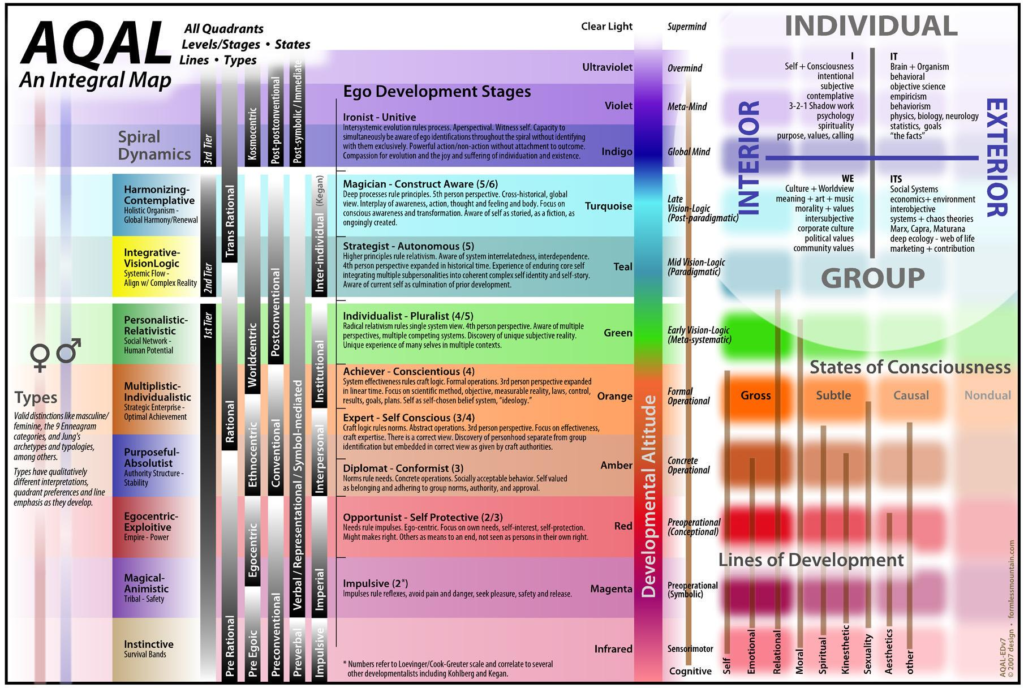
This has been documented enough in models like Maslow’s Hierarchy, Greuter’s stages of ego development, Spiral Dynamics, and Integral Theory, each building off of one another, but it’s also not difficult to observe in society.
I’ve talked about these many times, and synthesized them into my own
with various AI prompts to uncover your level of development and a path forward (open in a tab to read after if you’d like), but here’s the 80/20 of the 9 stages of ego development as a refresher (because repetition helps reveal things you didn’t notice before, and there are new people reading these letters):
Impulsive — No separation between impulse and action. Black and white thinking. I.e. A toddler hits when angry because the feeling and the behavior are the same thing.
Self-Protective — The world is dangerous and you learn to look out for yourself. I.e. A kid learns to hide report cards, lie about chores, and figure out what adults want to hear.
Conformist — You are your group and its rules feel like reality itself. I.e. Someone who genuinely cannot fathom why anyone would vote differently than their family or group.
Self-Aware — You notice you have an inner life that doesn’t match the exterior. I.e. Sitting in church and realizing you’re not sure you believe what everyone around you seems to believe, but not knowing what to do with that feeling yet.
Conscientious — You build your own system of principles and hold yourself accountable to them. I.e. Leaving your family’s religion after careful study and adopting a personal philosophy you can defend, or building a career plan with clear milestones because you believe the right effort yields the right results.
Individualist — You see that your principles were shaped by context and start holding them more loosely. I.e. Realizing your political views have more to do with where you grew up than objective truth, or noticing that your ambitious career goals were really about earning your father’s approval.
Strategist — You work with systems while aware of your own involvement in them. I.e. Leading an organization while actively questioning your own blind spots, or engaging in politics knowing your perspective is partial and shaped by bias you can’t fully see.
Construct-Aware — You see all frameworks, including your identity, as useful fictions. I.e. Holding your spiritual beliefs with metaphorically not literally, knowing the map is not the territory, or watching yourself play the role of “founder” or “thought leader” with a kind of gentle amusement.
Unitive — Separation between self and life dissolves. I.e. Work, rest, and play feel like the same thing. There’s no one left who needs to become something, just presence responding to what arises.
For most people reading this, I would assume you hover between 4 and 8, which is a huge gap. Those closer to 8 are reading this are doing so to either learn something or pass time in a non-destructive way. Those closer to 4 are really looking for a change. You feel like you are meant for more, but you can’t make sense of everything yet, because there’s obviously a lot at play.
The good thing is, it doesn’t really matter what stage you are in, because moving through any of them follows a pattern.
V – Intelligence is the ability to get what you want out of life
The only real test of intelligence is if you get what you want out of life. – Naval Ravikant
There is a formula for success.
One ingredient is agency.
One ingredient is opportunity (which many people like to mistake as “privilege” – because they the other ingredients).
The last ingredient is intelligence.
If you have high agency but low opportunity, it doesn’t matter how likely you are to act toward a goal, because it isn’t a goal that will bear much fruit.
If you have opportunity and agency but low intelligence, then you will never be fully able to benefit from that opportunity.
First, we’ve talked about agency before here. In terms of opportunity, I can’t tell you to change your physical location, but if you don’t see the abundance of digital opportunity right in front of you, I don’t know what to tell you.
With that said, I want to focus on what intelligence is in the context of these two other ingredients and this letter. For that, we look to cybernetics.
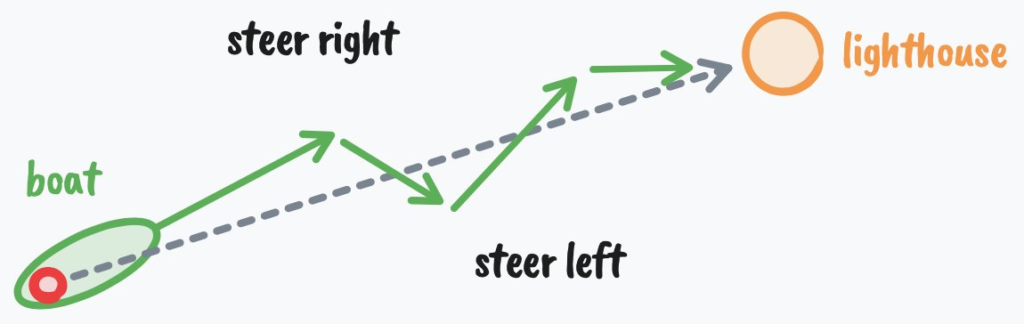
Cybernetics comes from the greek word kybernetikos which means “to steer” or “good at steering.”
It’s also known as “the art of getting what you want.”
So, if Naval’s definition of intelligence is getting what you want out of life, understanding cybernetics helps you do that much faster.
Cybernetics illustrates the properties of intelligent systems.
To have a goal.
Act toward that goal.
Sense where you are.
Compare it to the goal.
And act again based on that feedback.
You can judge intelligence based on the system’s ability to iterate and persist with trial and error.
A ship blown off course that corrects toward its destination. A thermostat sensing a change in heat and turning on. The pancreas excreting insulin after blood glucose spikes.
What does this have to do with getting what you want out of life?
Everything.
Acting, sensing, comparing, and understanding the system from a meta-perspective is fundamental to high intelligence (with the definition we are using here).
High intelligence is the ability to iterate, persist, and understand the big picture. The mark of low intelligence is the inability to learn from your mistakes.
Low-intelligence people get stuck on problems rather than solving them. They hit a roadblock and quit. Like a writer who fails to build a readership and quits because they lack the ability to try new things, experiment, and figure out a process that works for them (to think that there isn’t an effective process you can create is verifiably false, no matter your limiting beliefs, hence being low intelligence.)
High intelligence is realizing any problem can be solved on a large enough timescale. The reality is that you can achieve any goal you set your mind to.
Intelligence is realizing that there is a series of choices you can make which lead to achieving the goal you want. You understand that ideas are hierarchical and that you can’t go from papyrus to Google docs in one fell swoop. Even if that goal is impossible right now, you simply don’t have the resources – which may be invented over the next few years – to achieve that thing.
When I talk about “goals,” and as I will continue repeating, I am not speaking from the typical lens of self-help, although that’s a helpful lens to adopt at times.
I am speaking from the lens of teleology or the Greek kosmos – that everything serves a purpose. That everything is a part of a greater whole.
Goals determine how you see the world.
Goals determine what you consider “success” or “failure.”
You can try to “enjoy the journey,” but if you pursue the wrong goal, you will not enjoy it.
Your mind is the operating system for reality.
That system is composed of goals.
For most people, those goals are assigned to them. Programmed like lines of code in your psyche.
Go to school. Get the job. Get offended. Play victim. Retire at 65.
A known path that doesn’t work.
To become more intelligent, you must:
Reject the known path
Dive into the unknown
Set new, higher goals to expand your mind
Embrace the chaos and allow for growth
Study the generalized principles of nature
Become a deep generalist
I understand this may not be the traditional definition of intelligence, but that sequence of steps leads to an extraordinary level of connections in your brain, leading to what we would observe as an intelligent person. Pair that with agency and you’ve got a winner.
That leads us into the next section perfectly.
VI – How to launch into a completely new life (in 1 day)
The best periods of my life always came after a period of getting absolutely fed up with the lack of progress I was making.
How do you dig into your mind?
How do you become aware of your conditioning?
How do you reach profound insights and truths that change the trajectory of your life?
Through the simple, but often painful act of questioning.
Something that so few people do, and you can tell by how they speak or give their thoughts on a specific topic. Questioning is thinking, and very few people do it.
I want to give you a comprehensive protocol that you can use every year to reset your life and launch into a season of intense progress. This protocol helps you ask the right questions.
These questions will cover the macro to the micro: where you want to be, what you need to do to get there, and what you can do immediately to start moving the needle toward that reality.
This will require one full day to complete, so I recommend you follow along with the exact protocol. You will need a pen, paper, and an open mind.
When I observe patterns in people who successfully flip their identity, it happens fast after a build up of tension. Specifically, I’ve noticed 3 phases that people tend to go through.
Dissonance – They feel like they don’t belong in their current life, and become sufficiently fed up with their lack of progress.
Uncertainty – They don’t know what comes next, so they either experiment or get lost and feel worse.
Discovery – They discover what they want to pursue and make 6 years of progress in 6 months.
So, our goal with this protocol is to help you reach the point of dissonance, navigate through uncertainty, and discover what it truly is that you want to achieve, so much so that the clarity is overwhelming and distractions no longer hold their weight.
This protocol is structured so that it can be completed in one day. In the morning, you do a psychological excavation to uncover your own hidden motives. During the day, you prompt yourself with interrupts to keep you out of autopilot and contemplate your life. At night, you synthesize the insights into a direction you will start to move in tomorrow.
I cannot guarantee that this will work for everyone, because I cannot guarantee that everyone reading this is in the right chapter of their own story that would make these points impactful. You can’t place the climax at the start of the book and expect it to be interesting.
Part 1) Morning – Psychological Excavation – Vision & Anti-Vision
First we must create a new frame, or lens of perception, for your mind to operate from.
This is like creating a new shell, leaving your old one, and slowly growing into it over time. It won’t feel like it fits at first. That’s a good thing.
Set aside 15-30 minutes (the length of one YouTube video… you can do it) to think about and answer these questions. Do not attempt to outsource this contemplation to AI. I want you to break past the limiter that is on your mind. If you can’t answer these immediately, come back to them later.
What is the dull and persistent dissatisfaction you’ve learned to live with? Not the deep suffering but what you’ve learned to tolerate. (If you don’t hate it, you will tolerate it)
What do you complain about repeatedly but never actually change? Write down the three complaints you’ve voiced most often in the past year.
For each complaint: What would someone who watched your behavior (not your words) conclude that you actually want?
What truth about your current life would be unbearable to admit to someone you deeply respect?
Those questions are meant to make you aware of the pain in your current life. Now, we need to turn those into what I call an “anti-vision,” which is a brutal awareness of the life you do not want to live. That way, you can use that negative energy to aim your efforts in a positive direction and act from a place of intrinsic motivation.
If absolutely nothing changes for the next five years, describe an average Tuesday. Where do you wake up? What does your body feel like? What’s the first thing you think about? Who’s around you? What do you do between 9am and 6pm? How do you feel at 10pm?
Now do it but for ten years. What have you missed? What opportunities closed? Who gave up on you? What do people say about you when you’re not in the room?
You’re at the end of your life. You lived the safe version. You never broke the pattern. What was the cost? What did you never let yourself feel, try, or become?
Who in your life is already living the future you just described? Someone five, ten, twenty years ahead on the same trajectory? What do you feel when you think about becoming them?
What identity would you have to give up to actually change? (”I am the type of person who…”) What would it cost you socially to no longer be that person?
What is the most embarrassing reason you haven’t changed? The one that makes you sound weak, scared, or lazy rather than reasonable?
If your current behavior is a form of self-protection, what exactly are you protecting? And what is that protection costing you?
If you answered those truthfully, and if you are in the right chapter of your life, you will feel a deep sense of dis-ease and possibly disgust for how you are currently living. Now, we need to orient that energy in a positive direction. We need to create a minimum viable vision, because your vision is like a product. It starts out unclear, but with time and experience, it grows stronger and more potent.
Forget practicality for a minute. If you could snap your fingers and be living a different life in three years, not what’s realistic, what you actually want? What does an average Tuesday look like? Same level of detail as question 5.
What would you have to believe about yourself for that life to feel natural rather than forced? Write the identity statement: “I am the type of person who…”
What is one thing you would do this week if you were already that person?
Answer all of those first thing in the morning tomorrow.
Part 2) Throughout The Day – Interrupting Autopilot – Breaking Unconscious Patterns
These journaling exercises are cute, but we want real change.
Frankly, that’s not going to happen if you don’t break the current unconscious patterns that are keeping you the same.
Throughout the day, I want you to contemplate on everything you journaled in part one. Beyond that, I don’t want you to forget to contemplate. Please take this seriously. You aren’t going to change by doing the same thing for the rest of your life. You need to consciously force a pattern break.
Take the time right now to create reminders or calendar events in your phone. Include the question in the reminder or event so that you can immediately start thinking about it.
The more random and non-conflicting with your schedule there are, the better.
11:00am: What am I avoiding right now by doing what I’m doing?
1:30pm: If someone filmed the last two hours, what would they conclude I want from my life?
3:15pm: Am I moving toward the life I hate or the life I want?
5:00pm: What’s the most important thing I’m pretending isn’t important?
7:30pm: What did I do today out of identity protection rather than genuine desire? (Hint: it’s most things you do)
9:00pm: When did I feel most alive today? When did I feel most dead?
To add a bit more fuel to the fire, schedule these questions during times where you are either commuting, walking, or lying around.
What would change if I stopped needing people to see me as [the identity you wrote in question 10]?
Where in my life am I trading aliveness for safety?
What’s the smallest version of the person I want to become that I could be tomorrow?
Part 3) Evening – Synthesizing Insight – Entering A Season Of Progress
If you followed that process, I would be surprised if you didn’t have at least one profound insight that could alter the course of your life. Now, we need to make those known, integrate them into who we are, and act on them to begin solidifying our journey to a new level of mind.
After today, what feels most true about why you’ve been stuck?
What is the actual enemy? Name it clearly. Not circumstances. Not other people. The internal pattern or belief that has been running the show.
Write a single sentence that captures what you refuse to let your life become. This is your anti-vision compressed. It should make you feel something when you read it.
Write a single sentence that captures what you’re building toward, knowing it will evolve. This is your vision MVP.
Lastly, we need to create goals.
Again, these aren’t goals that you set for the sake of achievement, because goals are just projections. They are unreliable and make you feel bound to something that will inevitably change. Instead, think of goals as a point of view. A lens that you can exchange to enter the right state of mind to perform the action that will lead away from the life you don’t want. Do not worry about some kind of finish line, because as we will find, it doesn’t exist. Enjoyment is found in progress.
One-year lens: What would have to be true in one year for you to know you’ve broken the old pattern? One concrete thing.
One-month lens: What would have to be true in one month for the one-year lens to remain possible?
Daily lens: What are 2-3 actions you can timeblock tomorrow that the person you’re becoming would simply do?
That was a lot.
Hopefully it was helpful.
But we have one last piece to lock it all in.
Stick with me.
VII – Turn Your Life Into A Video Game
The optimal state of inner experience is one in which there is order in consciousness. This happens when psychic energy—or attention—is invested in realistic goals, and when skills match the opportunities for action. The pursuit of a goal brings order in awareness because a person must concentrate attention on the task at hand and momentarily forget everything else. – Mihaly Csikszentmihalyi
You now have all of the components that lead to a good life.
Now, it may be helpful to organize all of your insights into one coherent plan. Pull out a new page and write down these 6 components:
Anti-vision – What is the bane of my existence, or the life I never want to experience again?
Vision – What is the ideal life that I think I want and can improve as I work toward it?
1 year goal – What will my life look like in 1 year time, and is that closer to the life I want?
1 month project – What do I need to learn? What skills do I need to acquire? What can I build that will move me closer to the one year goal?
Daily levers – What are the priority, needle-moving tasks that bring my project closer to completion?
Constraints – What am I not willing to sacrifice to achieve my vision from the ground up?
Why is this so powerful?
Because these components literally create your own little world. If you are meant to pursue this hierarchy of goals at this stage of your life, you will have no other option but to become obsessed. You will feel the pull to something greater. You will not see anything else as an option.
You turn your life into a video game.
Because games are the poster child for obsession, enjoyment, and flow states. They have all the components that lead to focus and clarity, so if we reverse engineer what those components are, we can live in a state of deeper enjoyment, less distractions, and more success.
Your vision is how you win. At least until the game evolves.
Your anti-vision is what’s at stake. What happens if you lose or give up.
Your 1 year goal is the mission. This is your sole priority in life.
Your 1 month project is the boss fight. How you gain XP and acquire loot.
Your daily levers are the quests. The daily process that unlocks new opportunities.
Your constraints are the rules. The limitations that encourage creativity.
All of these act as a concentric set of circles, like a forcefield, that guard your mind from distractions and shiny objects.
The more you play the game, the stronger this force becomes, and soon enough it becomes who you are, and you wouldn’t have it any other way.
Every day, people make hundreds of small decisions without noticing. What to work on first. What to ignore. When to stop.
Over time, these decisions drain mental energy. This phenomenon is known as decision fatigue, and it quietly undermines focus, consistency, and long-term habits.
What Decision Fatigue Actually Is
Decision fatigue is the gradual decline in decision quality after prolonged mental effort.
It does not require complex choices. Repeated small decisions are enough.
Examples:
Choosing what task to start
Deciding when to take breaks
Constantly reprioritizing unfinished work
As mental energy decreases, people default to:
Avoidance
Impulsive choices
Inaction
Why Decision Fatigue Breaks Good Habits
Habits fail not because people lack motivation, but because decisions pile up.
When each action requires a fresh choice, consistency collapses.
This explains why relying on motivation rarely works long-term. Habits need fewer decisions, not more.